
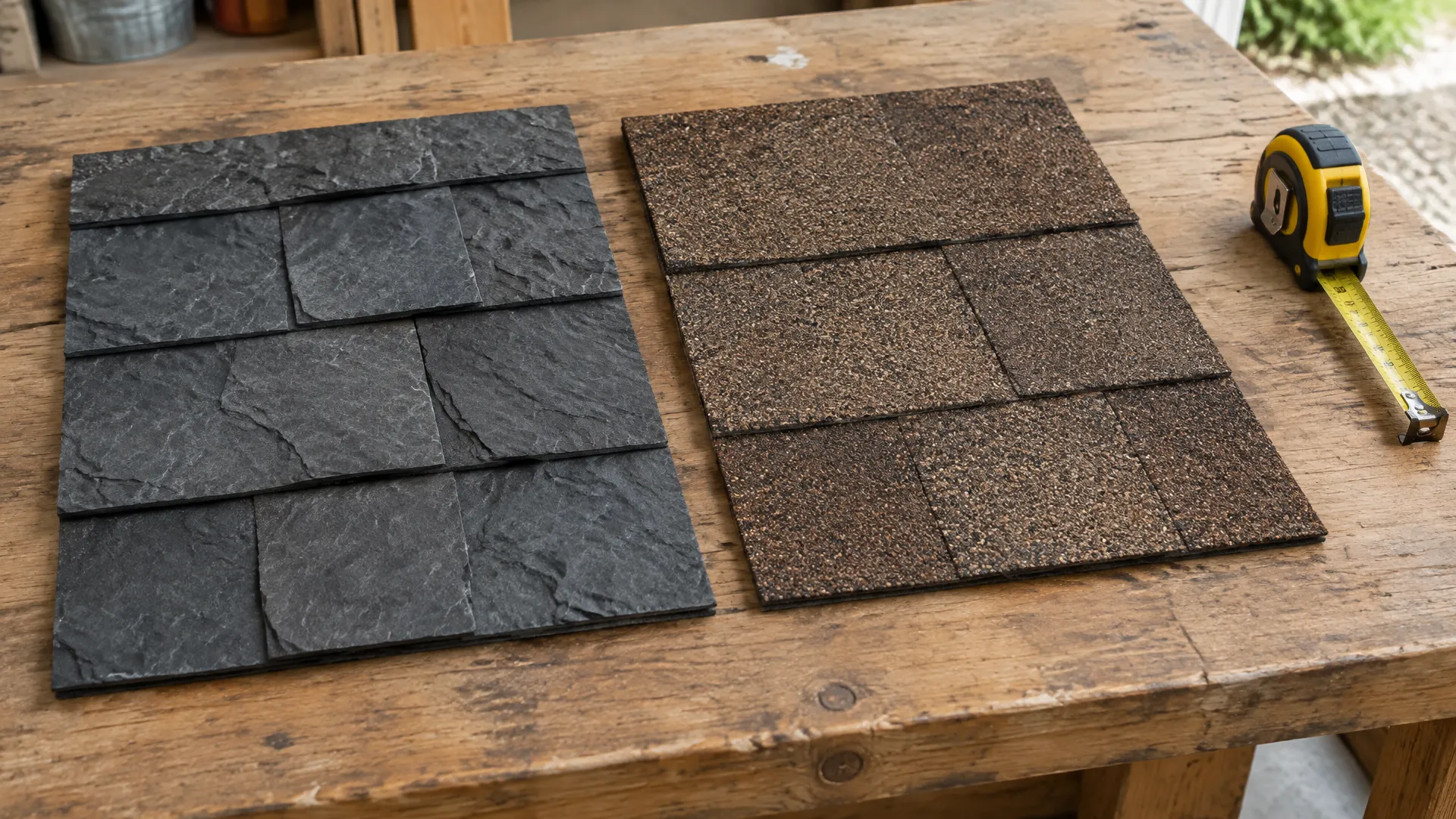
Composite vs Asphalt Shingles in Orangevale, CA
- 4.8 from 501 Reviews
- Workmanship Warranty
- Financing Available
- Insurance Claim Help
Composite and asphalt shingles can look alike from the street, but they are different products. Asphalt is the common shingle, and composite is a synthetic one. This page compares them for an Orangevale roof, using federal and university sources. To see what a composite job involves, read composite roof installation in Orangevale. Call (916) 526-3505 or ask for a free estimate, and we will go over both options with you.
What Is the Difference Between Composite and Asphalt Shingles?
The difference between composite and asphalt shingles is the material. The Department of Energy describes asphalt shingles as a fiberglass web coated with filled asphalt. It says polymer shingles are also known as synthetic or composite shingles. The National Park Service says some are molded from recycled plastic and rubber.
The National Park Service says asphalt shingles hold about two-thirds of the United States market for new and replacement roofs. The same agency calls recycled plastic and rubber shingles relatively new to the market. Newer products have fewer years of proof, so the comparison below leans on what the sources can back up.
Why Do Some Sources Call Asphalt Shingles Composition Shingles?
Composition shingles is an older name for asphalt shingles. The National Park Service says the roots of asphalt shingles are in composition roofing, which developed in the mid-1800s. The University of California fire guide uses the name too. It lists fiberglass asphalt composition shingles as a Class A roof covering.
Composite is a different word with a different meaning. The Department of Energy uses it for synthetic polymer shingles. A bid that says composition usually means asphalt, and one that says composite means a synthetic shingle. Ask the roofer to write out the material by name.
How Do Composite and Asphalt Shingles Compare?
The table sets the two side by side using the sources named on this page. The fire classes come from the UC roof fire guide. The composite column follows the sources on recycled plastic and rubber shingles.
| Point | Composite (recycled plastic and rubber) | Asphalt (composition) |
|---|---|---|
| Made of | Polymer shingles. Some products use recycled plastic and rubber. | Fiberglass, asphalt cement, ceramic-coated rock and mineral filler. |
| Look | Can duplicate the look of slate tiles. | Ceramic granules allow a wide range of colors. |
| Fire class alone | Class C, per the UC guide. Typically Class A with added underlayment. | Class A for fiberglass asphalt composition shingles. |
| Track record | Newer to the market. Makers have not proved longevity claims. | About two-thirds of the United States market for new roofs and replacements. |
| Cost note | Relatively expensive compared with asphalt. | Relatively inexpensive. |
| Heat tip | Choose factory-colored shingles with light or cool pigments. | Choose light or cool-colored granules. |
The table does not name a winner, and neither do the sources. Each row points to a question for your roofer. The fire class row deserves the most attention, so the next section takes it apart.
What Do Fire Classes Mean for an Orangevale Roof?
A fire class is a rating from A to C, and Class A is the top one. Some coverings rely on an underlying material, or a special install, to improve their rating. The guide names a mineral-surfaced cap sheet as one common underlying material. So ask whether a composite quote leans on added layers.
The University of California guide says local additions to the code may exist in your community. It adds that your local authorities can provide more information. For a home in Orangevale, the county to ask is Sacramento County.
What Should You Ask a Roofer Before Choosing in Orangevale?
Start with a plain question for every roofer. Which shingle are you quoting, and what is it made of? Then work down the short list below. Homes near Oak Avenue and across the rest of Orangevale call for the same questions.
- The material. Ask for the shingle type in writing, asphalt or composite, so the quote cannot be read two ways.
- The fire class. Ask for the class, and whether the roof depends on added layers to earn it.
- The instructions. Ask the crew to follow the listing and the maker's instructions for that exact shingle.
- The proof. Ask what backs a longevity claim, since the Park Service says makers of recycled shingles have not proved theirs.
Porter Roofing installs shingle roofs, so one visit can cover both. Describe any stain or drip you notice from inside the house. Bring any bids you already hold, and we will read them with you.
What Changes the Cost of Composite and Asphalt Roofs?
Nobody can name your price before a roofer sees the roof. The sources do give a few clues. Three things move the total from one shingle to the other.
The shingle itself.The Park Service calls recycled plastic and rubber shingles relatively expensive compared with asphalt.
The layers underneath.A roof rated by assembly needs the underlying material its rating calls for, and that adds to the job.
The size and shape of the roof.A larger roof takes more of whichever shingle you pick.
A written estimate that names the shingle, its fire class and its layers makes two bids easy to compare. Porter Roofing prices both shingles with a free estimate. Financing available.
Ask for a free estimate and we will write up each shingle by name.
Questions About Composite and Asphalt Shingles
Composite shingles are not better than asphalt shingles for every home, and the sources name no winner. Asphalt has the larger market, per the National Park Service. It also has a Class A rating on its own, per the University of California guide. Recycled composite shingles can copy the look of slate, but their longevity claims are unproved. Porter Roofing can compare both on your roof with a free estimate.
Yes, composition shingles usually means asphalt shingles. The National Park Service traces asphalt shingles to composition roofing. The University of California fire guide lists fiberglass asphalt composition shingles. Composite is a different word. The Department of Energy says synthetic shingles are also called composite. If a quote is unclear, ask for the material by name. Porter Roofing can explain the terms on a bid when you ask for a free estimate.
Asphalt shingles have the better fire class on their own, going by the University of California guide. It lists fiberglass asphalt composition shingles as Class A. It lists recycled plastic and rubber coverings as Class C alone, though they typically reach Class A with added underlayment. Ask for the class and any added layers in writing. Porter Roofing will talk through the classes when you ask for a free estimate.
The sources do not show that composite shingles last longer. The National Park Service calls recycled plastic and rubber shingles new to the market. Their makers have not proved longevity claims. It also says early use shows they are proving very durable. Ask the maker what backs any life claim, and get the warranty terms in writing. Porter Roofing can price both shingles with a free estimate.
Shingle color can matter, and the Department of Energy gives advice for both types. It says to pick asphalt shingles with light-colored granules, or cool-colored granules for a darker look. For polymer shingles, it says to choose factory-colored ones with light or cool pigments. It warns that coating old asphalt shingles can trap moisture. Porter Roofing can weigh color choices for your home in a free estimate.
Request a Free Shingle Estimate in Orangevale
Tell us what you are weighing using the form below, or call (916) 526-3505.